
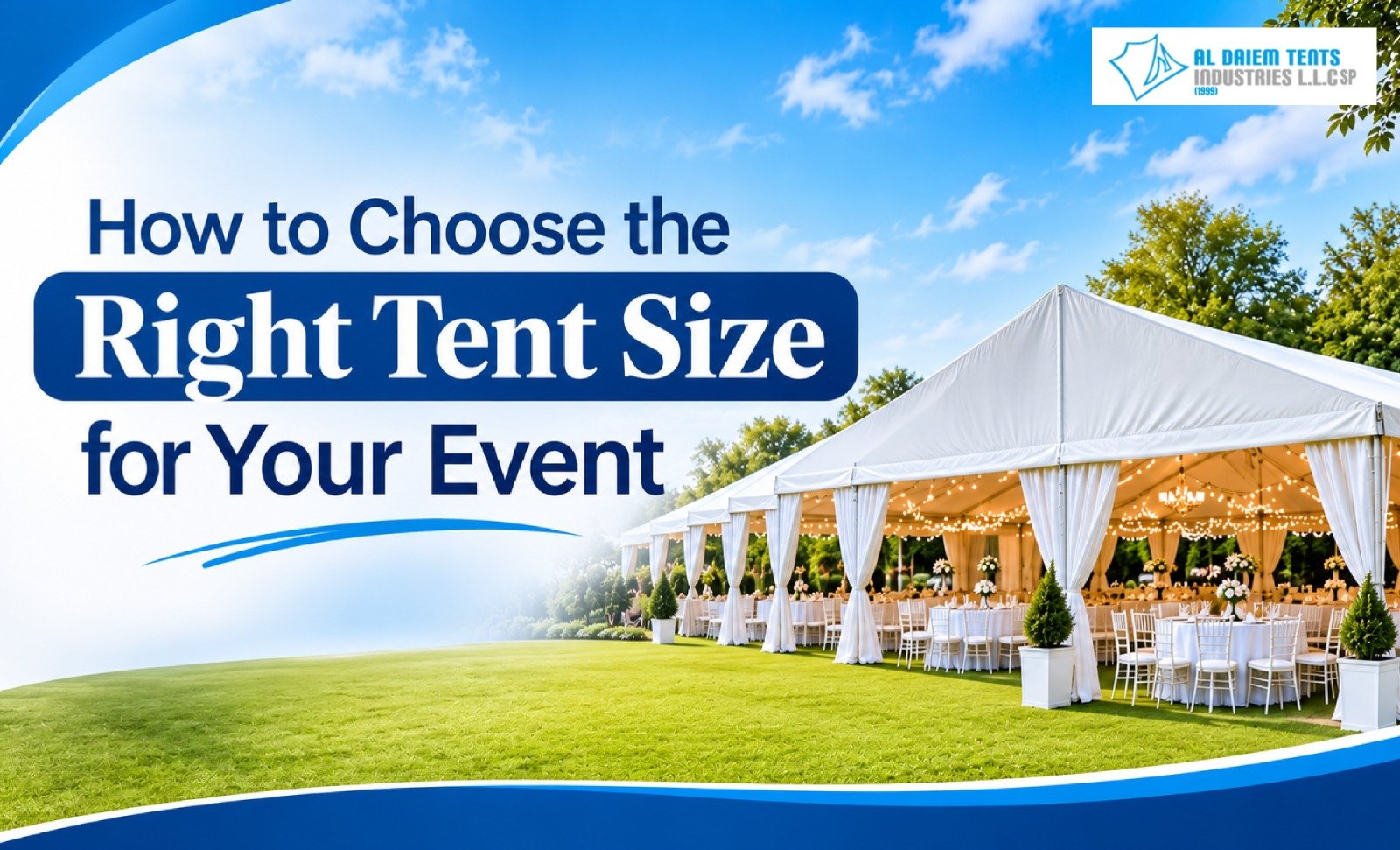
Planning an outdoor event involves a number of decisions, but tent size is probably the most important. If you’re planning a wedding, a corporate function, an exhibition, a private function or a large outdoor event, the tent you pick is going to have a massive impact on the comfort of your guests, the way the event is laid out and the overall experience.
A tent that’s too small can make the whole thing feel a bit cramped and uncomfortable. A tent that’s too big, on the other hand, can be a cost driver (higher rental cost), will need a lot more space to install, and can just leave the venue looking rather empty.
So how do you work out the right tent size for your event?
Here are the key factors to bear in mind prior to making your decision.
1. Start With Your Guest Count
The first thing you need to do when choosing a tent is work out how many people you’re expecting to attend your event.
However, just counting the number of guests isn’t the be-all and end-all. You also have to think about how they’re going to use the space.
However, just counting the number of guests isn’t the be all and end all. You also have to think about how they’re going to use the space.
For example:
A standing cocktail event takes up less space per head.
A seated dinner will require additional space for the tables and chairs.
A wedding reception might need room for dining, dancing and entertainment.
A corporate conference needs to have space for seating, space for presentations and space for movement.
As a general planning guideline, consider the following approximate space requirements:
Event Setup
6–8 sq. ft.
Standing reception: Theatre-style seating
8–10 sq. ft.
Standing reception: Banquet seating
10–12 sq. ft.
Standing reception: Classroom-style seating
12–15 sq. ft.
These are initial estimates only, not fixed requirements. The actual space needed will depend on the size of the furniture, the circulation areas and the layout of the event.
2. Consider the Type of Event
Different events will have different space requirements even if the number of guests is the same.
For example, a corporate networking event with 100 people might only need an open standing area, whereas a wedding with 100 people could well require dining tables, a stage, a dance floor, and a buffet.
For example a corporate networking event with 100 people might only need an open standing area whereas a wedding with 100 people could well require dining tables, a stage, a dance floor and a buffet.
Before you select a tent, you need to establish the primary purpose of the event.
Before you select a tent you need to establish the primary purpose of the event.
Consider these examples:
- Weddings and social celebrations will generally require separate areas for dining, entertainment, guest seating and the ceremony.
- Corporate events (product launches, conferences, business events, etc.) will all require presentation stages, exhibition booths, registration desks, and networking areas.
- Corporate events: product launches, conferences, business events etc will all require presentation stages, exhibition booths, registration desks and networking areas.
- Exhibitions and trade shows need extra space for display structures, visitor movement, product demonstrations, and storage.
- Exhibitions and Trade Shows: need extra space for the display structures, the movement of visitors, the product demonstrations and for storage.
- Private parties (birthdays, anniversaries, family get-togethers, etc.) may require flexible layouts for seating, dining, and entertainment.
Private parties (birthdays, anniversaries, family get togethers etc) may require flexible layouts for seating, dining and entertainment.
Understanding the event format will help you to pick a tent that will support the whole experience rather than just the number of guests.
3. Account for Furniture and Additional Equipment
One of the most common errors people make when selecting a tent is working out the space required purely on the basis of the number of people.
One of the most common errors people make when selecting a tent is to work out the space required purely on the basis of the number of people.
Remember, guests aren’t the only thing in the tent.
Remember guests aren’t the only thing in the tent.
Tables, chairs, buffet counters, stages, sound systems, lighting, decorations and registration desks all need space.
A banquet-style arrangement will obviously take up more space than an open standing arrangement, as the tables and chairs themselves take up so much floor space.
A banquet style arrangement will obviously take up more space than an open standing arrangement as the tables and chairs themselves take up so much floor space.
It’s also important to leave adequate walking space between the tables, the entrances and the various activity areas.
A well-thought-out tent should allow guests to move about freely without having to constantly go round and round furniture and gear.
A well thought out tent should allow the guests to move about freely without having to constantly go round and round furniture and gear.
4. Think About the Tent Layout
The shape and layout of a tent can have a bearing on how efficiently you can use the space available.
Common tent configurations include:
Rectangular tents: for dining, corporate functions, exhibitions and all the associated seating.
Square tents: useful for smaller functions and events where you’ve got a fairly even seating arrangement.
Clear Span Structures: ideal for larger events where you need an open interior and don’t want any internal support poles to be in the way of the usable floor area.
Pagoda Tents: frequently used for entrance areas, registration desks, hospitality areas and smaller event areas.
For bigger events, you can have a number of interconnected tent structures to create separate areas for dining, entertainment, back of house, and guest accommodation.
For bigger events you can have a number of interconnected tent structures to create separate areas for dining, entertainment, back of house and guest accommodation.
The correct configuration will, of course, depend on your venue, the nature of the event, and the amount of space you have available for installation.
The correct configuration will of course depend on your venue, the nature of the event and the amount of space you have available for installation.
Before you finalize your tent dimensions, take care to measure the site of installation.
Before you finalise your tent dimensions, take care to measure the site of installation.
A tent may look spot on in terms of size on paper, but may not actually fit in the venue.
A tent may look spot on in terms of size on paper but may well not actually fit in the venue.
Check the following:
Total available ground area.
Ground conditions and surface level.
Nearby buildings, trees and other obstacles.
Access points for guests and for installation teams.
Space required for tent anchoring and support systems.
Emergency exits and vehicle movement.
You should also allow for additional space around the tent for installation, for maintenance and for safe access.
If your event is being held in a location with limited space, a professional tent supplier can help you identify the right tent and layout.
If your event is being held in a location with limited space then a professional tent supplier can help you to identify the right tent and layout.
6. Don’t Ignore Weather and Seasonal Conditions
Weather conditions are another major consideration when it comes to choosing an event tent.
In Dubai and other parts of the UAE, outdoor events have to be planned with the extreme sun, heat, wind, and occasional rain in mind.
In Dubai and other parts of the UAE outdoor events have to be planned with the extreme sun, heat, wind and occasional rain in mind.
A tent chosen purely on floor area (ignoring weather protection) can cause issues during the event.
Depending on the location and season, you may need:
Proper ventilation and airflow.
Air-conditioning compatibility.
Sidewalls for further weather protection.
UV-resistant and weather-resistant fabric.
Appropriate structural support and anchoring systems.
For big outdoor events, structural integrity and professional installation are the key issues.
A tent of the right type will provide both adequate space and a comfortable environment for the guests.
7. Plan for Future Changes and Unexpected Requirements
Event planning almost never proceeds precisely according to the original plan.
The number of guests could go up, more equipment may be required, or the layout of the event may change at the last minute.
The number of guests could go up, more equipment may be required or the layout of the event may change at the last minute.
This is why it makes sense to allow for a reasonable amount of space when you’re choosing a tent.
Don’t pick dimensions that leave absolutely no scope for adjustment.
An extra buffer can be useful in the event of unexpected guests, extra seating, equipment or changes to the programme.
The aim isn’t to rent the biggest tent you can. It’s about finding a sensible middle ground between space, comfort and cost.
8. Consult a Professional Tent Supplier
Even with the most careful planning, choosing the right tent size can be a real challenge when looking at large corporate events, exhibitions, and outdoor functions.
Even with the most careful planning, choosing the right tent size can be a real challenge when you’re looking at large corporate events, exhibitions and outdoor functions.
An experienced tent supplier can assess your requirements, recommend the right size, evaluate the site conditions, and help you plan the installation.
An experienced tent supplier can assess your requirements, recommend the right size, look at the site conditions and help you with the planning of the installation.
They can also advise on the structural requirements, the flooring, the lighting, the air conditioning and the weather protection.
Professional guidance will help you avoid the common planning pitfalls and make sure the end result is going to meet the practical requirements of your event.
Final Thoughts
Choosing the right tent size is about so much more than just working out how many people you’re going to fit. It’s about the format of the event, the layout you’re going to have, the equipment you’re going to have to accommodate, the venue itself and the weather.
A well-sized tent creates a comfortable environment, facilitates guest movement, enables the event to run smoothly, and makes better use of your budget.
A well sized tent creates a comfortable environment, facilitates guest movement, enables the event to run, and makes better use of your budget.
Whether you’re putting on a small outdoor get-together or a major corporate event, take the time to work out your space requirements before you finalize the layout.
Whether you’re putting on a very small outdoor get together or a major corporate event, take the time to work out your space requirements before you finalise the layout.
At Al Daiem Tents, the right event structure starts with understanding your requirements. From selecting suitable tent dimensions to planning functional outdoor spaces, careful design and professional installation can make all the difference to your event experience.
